Physical Address
304 North Cardinal St.
Dorchester Center, MA 02124
Physical Address
304 North Cardinal St.
Dorchester Center, MA 02124

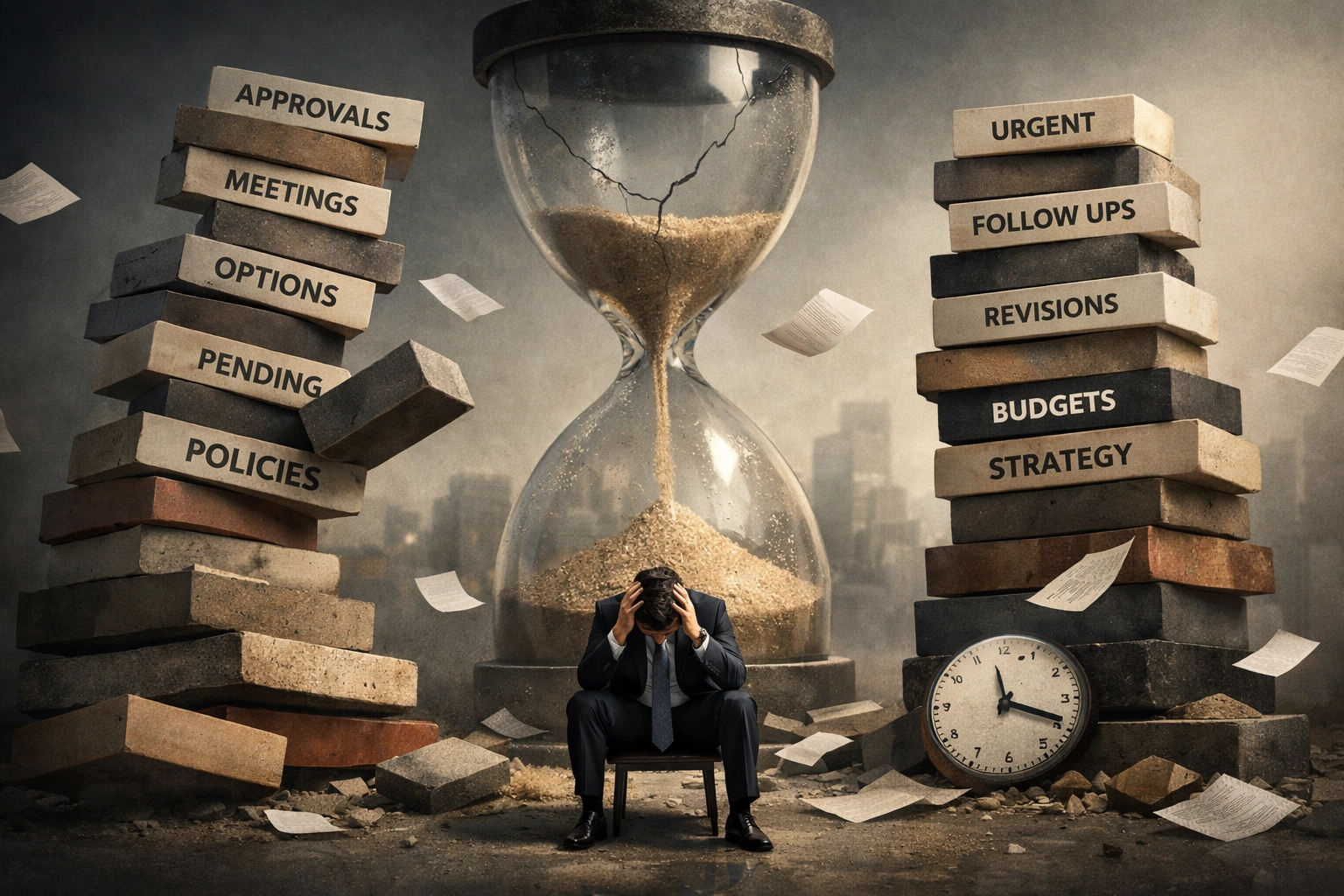
You're not drowning in email. You're drowning in the 300+ micro-decisions email forces you to make daily.
Every Slack notification. Every meeting request. Every forwarded thread with "thoughts?" at the top. Each one carries the same invisible weight: Do I respond now? Can this wait? Who else needs to see this? Is this actually urgent or just marked urgent?
This is decision debt, the accumulated cognitive load of thousands of tiny choices that never make it onto your task list but consume more mental energy than the work itself.
Most productivity advice fixates on time management. Block your calendar. Batch your email. Say no more often.
But here's what the frameworks miss: You're not running out of time. You're running out of decision-making capacity.
Research from behavioral economists shows the average person makes 35,000 remotely conscious decisions daily. For executives managing teams, projects, and P&Ls, that number skews higher. And unlike time, which resets at midnight, decision-making capacity depletes throughout the day and doesn't fully recover overnight when chronic stress is involved.

The exhaustion you feel at 3 PM isn't from working. It's from deciding about work. Whether to work. How to prioritize work. Who should do the work.
A 2025 study of C-suite executives found that 52% spend 30% of their day on busywork, administrative tasks that feel productive but don't move strategic goals forward. The real drain? It's not the busywork itself. It's the continuous mental triage of deciding what qualifies as busywork versus what actually matters.
Let's audit a single morning:
6:47 AM: Phone buzzes. Email from a direct report marked "urgent." Decision: Read now or wait until I'm at my desk?
7:12 AM: Slack message in three channels. Decisions: Which one matters most? Do I respond now or risk looking unavailable?
8:03 AM: Calendar invite for a "quick sync." Decisions: Is this meeting necessary? Will I offend someone by declining? What if I accept and it's a waste of time?
8:45 AM: Email thread with 14 people CC'd, no clear ask. Decisions: Am I expected to respond? What's my role here? Should I reply-all or direct?
By 9 AM, you've made 40+ decisions and haven't started actual work.
Each micro-decision feels trivial in isolation. But they compound. Cognitive scientists call this decision fatigue, the deteriorating quality of choices after making many decisions, even small ones. It's why you can negotiate a complex deal in the morning but can't pick a restaurant at dinner.

The corporate communication stack makes this exponentially worse. Email, Slack, Teams, text, phone, LinkedIn messages, each platform creates its own decision tree. Every notification is a micro-interruption demanding a micro-decision about whether it deserves a macro-response.
The paradox of progress: Every tool meant to reduce workload creates new decision layers.
AI outputs need review. Which recommendations do you implement? Data dashboards need interpretation. Which metrics actually matter? Automation workflows need oversight. When do you intervene manually?
Founder CEOs now toggle between 8-12 platforms daily. Email, CRM, project management, Slack, financial dashboards, HR systems, marketing analytics, AI copilots. Each one surfaces information that theoretically helps you make better decisions.
In practice? More information means more decisions about what information matters.
The 2026 executive stack doesn't reduce cognitive load, it redistributes it. You're not answering emails manually anymore. But now you're deciding whether the AI-drafted response captures the right tone, whether the meeting AI scheduled conflicts with an unspoken priority, whether the data AI surfaced is actually relevant.

A recent analysis of 10,000+ executive calendars found that leadership roles now involve 60% more context-switching than in 2022. More tools. More tabs. More decisions about where to focus next.
Here's the cruelest irony: Success creates more decision complexity, not less.
When you're managing a team of five, decisions are relatively contained. When you're managing 50? Every decision has downstream implications across multiple people, projects, and timelines.
Growth introduces compounding decision branches:
The executive who complains "I can't find time to think strategically" isn't lazy. They're trapped in a decision cascade where daily operational choices crowd out the space needed for bigger thinking.
And the default response, delegating more, hiring an EA, creating systems, often adds new decisions. Now you're deciding what to delegate, how to delegate it, whether it was delegated correctly, and when to step back in.
Here's what makes decision debt insidious: It feels like personal failure.
When someone says "I have too many meetings," that's an external complaint. The system is broken. The company has meeting bloat. There's organizational sympathy.
But decision fatigue manifests differently. You blame yourself.
"Why can't I just power through this inbox?"
"Other CEOs seem to handle this fine."
"Maybe I'm not cut out for this level of responsibility."
The internal narrative shifts from "This is unsustainable" to "I'm not good enough." Because making decisions is supposed to be what leaders do. Admitting you're overwhelmed by decisions feels like admitting you're overwhelmed by leadership itself.

Burnout research increasingly points to autonomy and control as key factors. The problem isn't workload volume. It's the feeling that you're constantly reacting instead of directing. That every decision is forced on you rather than chosen strategically.
When 70% of your decisions are reactive, responding to someone else's urgent request, you've lost agency over your own cognitive bandwidth.
Decision debt can't be eliminated. But it can be managed intentionally.
The most effective approach? Automate the recurring micro-decisions that don't require your unique judgment.
Email triage is a perfect example. The decision "Does this email need my immediate attention?" gets made 100+ times daily. The actual answer changes, but the decision framework doesn't. Urgent from key stakeholders: Yes. FYI updates: No. Sales pitches: Definitely not.
AI systems now handle this pattern recognition at scale. Platforms like Mobina automatically categorize emails using a P1-P5 urgency framework: immediate action items (P1) down to newsletters and marketing (P5). Instead of deciding 100 times whether something matters, you make one decision: trust the prioritization system.
The same logic applies to calendar management, meeting prep, and research requests. The decisions still happen. You're just not the one spending cognitive energy on them.

For professionals managing 200+ daily emails and 15+ meeting requests weekly, AI-powered executive assistants automate routine decision-making without removing human oversight. Mobina connects to existing Gmail and Google Calendar systems to handle email prioritization, response drafting, and scheduling conflicts: processing what previously took hours of mental triage in seconds.
The value isn't just time saved. It's decision capacity preserved for work that actually requires your strategic thinking.
Track your micro-decisions for three days. Note every time you have to decide whether to respond, whether something is urgent, whether to attend a meeting. You'll likely count 200-300 decision points that follow predictable patterns.
Those patterns? That's where automation creates real leverage. Not by working faster. By deciding less.

![[HERO] The 2026 Executive Tech Stack: Tools to Eliminate Administrative Busywork](https://www.getmobina.com/wp-content/uploads/2026/02/blog-150x150.png)